There are new curling formats growing in Canada. Do you want to join in these formats. Please read the guidelines and then send an email to This email address is being protected from spambots. You need JavaScript enabled to view it. whether or not you are interested. It will then determine if we include these in our line-up this season. Deadline for response by Friday, September 18th, please
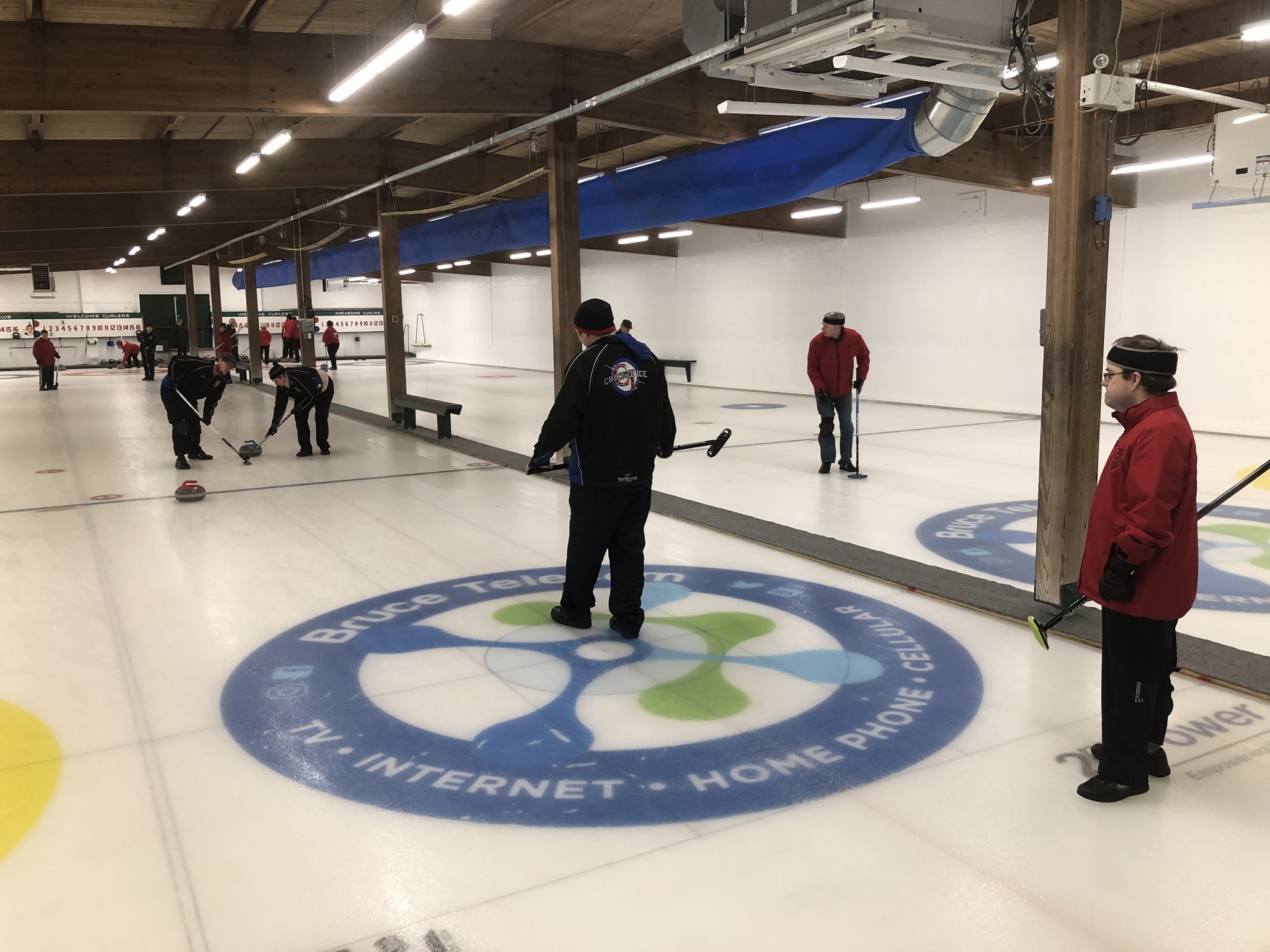
Triples Curling is a new exciting discipline that has been developed by Curling Canada. As it name suggests, curlers compete in teams of 3 when playing Triples. Each end consists of 6 shots per team, with each player throwing 2 shots per end. Unless otherwise indicated, Curling Canada rules apply to Triples, including those related to the Free Guard Zone and No-Tick.
Pre-Game Practice: Consists of each player throwing 2 rocks up and 2 rocks back. However, one of the unique features of Triples is that both teams pract at the same time, with one team thowoing on the left side of the sheet and the other on the right. A coin takes place immediately before practice, with the winner choosing side of sheet or rock colour. Then, the teams throw their practice rocks in alternation, just as they would in a gam. This provess rdueces the time required for Pre-Gram Practicew to the point that is hsoul take no more than 10 minutes total.
Game Structure: Triples games consist of 2 sets of 2 ends each. Each set is effectively a mini-game, with the team with highest cumulative score after 2 ends winning that set. However, if both teams have the sanme number of points, that set is considered tied.
Hammer Allocation:
- End 1 of Set 1, hammer is decided by a coin toss.
- Hammer in End 1 of Set 2 reverses from the End 1 of Set 1.
- Hammer in End 2 of Set 3 goes to the team that is trailing the game.
- If the score is tied heading into Set 3, another coin toss is used to determine which team starts Set 3 with hammer.
Blank Ends: In Triples, blank ends are not allowed. This means if a team inadvertently blanks End 1 of a set, hammer for End 2 is awared to the other team.
Throwing Order: One of the defining features of the Triples discipline is that curlers are required to play different position (i.e., lead, middle, and skip for each set of the game. Teams can determine which player starts at each position in Set 1. However, from that point onward the rotation of players must be as follows:
- Set 1: Play 1 = Lead, Player 2 = Middle, Player 3 = Skip
- Set 2: Player 3 = Lead, Player 1 = Middles, Player 1 = Skip
- Set 3: Player 2 = Lead, Player 3 = Middle, Player 1 = Skip
Sweeping: Only 1 player is allowed to sweep rocks until the far hog-line. After that point, 1 of the other curlers can join in.
Set Values: In order to ensure that a full Triples game is played, the value assigned to Set 3 is greater than it is for Sets 1 and 2. The specific set values are as follows:
- Set 1: 1 Points Available (1 Point/Team if Set is Tied)
- Set 2: 2 Points Available 1 Point/Team if Set is Tied)
- Set 3: 4 Points Available (2 Points/Team if Set is Tied)
These differing set values ensure that all 3 sets are always reqwuired. That is, even if Team A wins Set 1 and 2, and therefore leads the game 4-0, it is still possible for Team B to tie the game by winning Set 3 outright, since the score would now be 4-4.
Tied Games: If the game is tied after Set 3 a "Team shootout" is used.
- This involves each player throwing alternating draws with the other team.
- The throwing order and positional duties are the same as in Set 3, with the team that last had hammer throwing first in the shootout.
- The sweeping rules are also the same, except you cannot sweep opposition rocks behind the t-line.
- The scoring system is 5 points (pin), 4 points (button), 3 points (4-foot), 2 points (8-foot) and 1 point (12-foot)